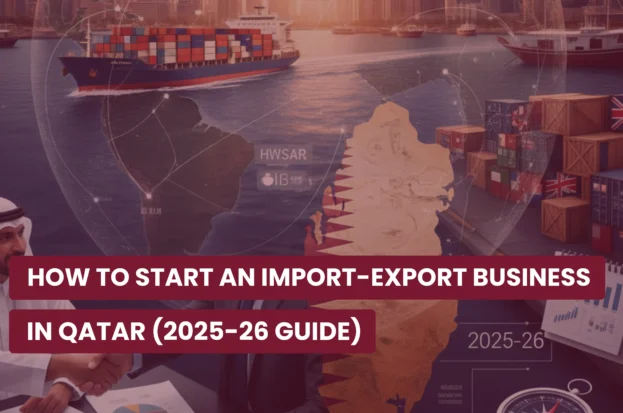
Qatar presents a compelling opportunity if you’re considering an import-export business in Qatar. With rising consumer demand, strong logistics infrastructure and regulatory reforms favouring trade, now is the time to plan and act. In this guide, we’ll walk you through every major step: company registration, licensing, product and market selection, compliance and scaling all tailored to 2025-26. You’ll gain concrete actions, not vague advice.
Why Qatar? The Trade & Business Opportunity
Qatar’s economy is highly trade-oriented and heavily dependent on imports for many consumer and industrial goods. Because domestic production is limited, many goods, from food to construction materials, must be brought in.
Its strategic location, modern infrastructure (ports, airports), and pro-business regulatory environment make it a strong base for a trade firm. According to one guide, importing and exporting in Qatar requires a clear understanding of regulatory steps but benefits from comparatively efficient logistics.
If you can get ahead now, choosing the right products, managing compliance and building local networks, you’ll be positioned ahead of later entrants.
Step 1 – Business Structure & Company Registration
Your first task is choosing how to legally establish your trade company. In Qatar you might opt for a Limited Liability Company (LLC), a branch of a foreign firm or operate via a free-zone structure.
Make sure your chosen structure clearly allows import-export activities and foreign ownership if you’re non-Qatari. Then:
- Reserve a business name via the Ministry of Commerce and Industry (MoCI).
- Draft your Memorandum of Association (MOA) / Articles of Association (AOA) outlining that one of your objectives is import-export trade.
- Open a bank account and deposit required share capital (if relevant).
- Register your company with MoCI to receive your Commercial Registration.
- Apply for trade licence and include “import-export” as part of the business activities.
- Obtain the establishment/computer card (links your company to immigration and labour systems).
- Register for a Tax Identification Number (TIN) and ensure your operations are compliant with Qatar’s tax regime (corporate tax generally 10% but many trade firms may benefit from exemptions).
- Check the HS (Harmonised System) code of your product → this determines tariff and regulatory treatment.
- Review duties, non-tariff barriers, labelling or packaging rules.
- Select markets: start by importing into Qatar domestic market; as you scale, consider exports from Qatar into neighbouring Gulf states.
- Ensure your goods meet GCC/Qatar standards for labelling, safety, packaging.
- Choose logistics partners experienced with Doha’s main hub, Hamad Port.
- Account for warehousing, transport from port to your final market.
- Ensure you have a customs broker or freight forwarder in Qatar who handles customs clearance smoothly.
- Join the Qatar Chamber of Commerce and Industry (QCCI) for trade introductions.
- Attend industry trade shows in Qatar to meet suppliers, logistics providers, buyers.
- Consider partnering with a local distributor initially, then later developing direct channels.
- Currency/exchange rate fluctuations (though QAR is pegged to USD which reduces some risk).
- Regulatory changes (tariffs, standards).
- Quality issues from suppliers leading to returns or reputation damage.
- Delays in shipment which increase cost.
- Expand your product lines once your logistics are proven.
- Leverage Qatar’s ambition for economic diversification: non-oil sectors are being boosted.
- Consider re-exporting: import goods into Qatar’s free zone, then export to GCC or other markets.
- Use digital tools: e-commerce, social media marketing to reach customers across Qatar and the region.
- Choosing product without checking regulation: e.g., importing food or pharma without health certification leads to delays.
- Underestimating logistics cost/time: transit and clearance may cost more than expected.
- Weak supplier due diligence: leads to quality issues, returns, customer complaints.
- Registering wrong business activity: you might not be licensed for “import-export” specifically and be blocked.
Being precise at this stage avoids delays later when you apply for trade licences.
Step 2 – Licensing, Commercial Registration & Official Formalities
Once your structure is in place, you must obtain the relevant business licences: a trade licence permitting import-export, your Commercial Registration (CR), and any establishment cards required to hire staff. Guides emphasise that operating without the correct licence means you cannot legally import or export.
Typical steps:
Tip: Have your office lease, identity documents, shareholder details and capital deposit proof ready before your licence application — this speeds up approval.
Step 3 – Product & Market Selection
Choosing the right product lines is where many entrepreneurs make or break their import-export business in Qatar. Some products have heavy regulation or low margins. Using data: items with strong import potential include iron and steel, pharmaceuticals, cereals, rubber and articles.
You’ll need to:
Recommendation: Begin with one or two product lines. Import samples to test demand, logistics, clearance experience. Don’t over-diversify too soon.
Step 4 – Compliance, Customs & Logistics
Even if you have strong product selection, failure on compliance or logistics can cripple you. In Qatar, all imports and exports are subject to oversight by the General Authority of Customs (GAC). Documents like commercial invoice, packing list, certificate of origin, bill of lading are mandatory.
Key considerations:
If you skip this step, even a good product will get stuck at the port or incur major unexpected costs.
Step 5 – Local Partner, Networking & Free-Zone Advantage
While full foreign ownership is now allowed in many sectors, having local networks remains highly beneficial. A local partner/distributor can help you with approvals, local customs nuance and customer access. The Qatar Free Zones Authority (QFZA) also offers free-zones with advantages: 100% foreign ownership, duty-free imports for storage/transit, and incentives.
Networking tips:
Step 6 – Financial Planning, Pricing & Risk Management
Import-export business in Qatar isn’t just about shipping goods; it’s about margin, cost control and risk. You must map: setup costs (license, rental, registration), import costs (freight, customs duties), warehousing, marketing and distribution.
For pricing: landed cost (including clearing, transport) + your margin + local distribution costs = your selling price.
Major risks:
Actionable tip: Start with smaller shipment volumes to test your supply-chain and market demand before committing large capital.
Growth Strategy & Scaling (2025-26 Specific)
To grow your import-export business in Qatar, consider these moves:
The 2025-26 window is important: regulatory reforms and infrastructure projects in Qatar are accelerating, so trade firms that establish now will benefit from the momentum.
Common Pitfalls & How to Avoid Them
Avoidance strategy: Do your homework, check HS code, product classification, engage local support early, keep margin for surprises.
Conclusion
If you follow the roadmap above, launching an import-export business in Qatar becomes a structured, manageable endeavour rather than a gamble. The term “import-export business in Qatar” doesn’t just refer to moving goods; it’s about bridging markets, compliance, logistics and growth strategy. With the right structure, licences, chosen products, and local networks, you can build a trade-business positioned for the 2025-26 period and beyond.
If you’d like help in setting up your operation, company registration, licensing, partner hunt or marketing strategy, our team at RAG is ready to support your journey.
Let’s build your import-export venture together.
March 18, 2026
Complete Guide to Business Formation in Qatar
March 10, 2026
Risk Management Strategies for Businesses Operating in the GCC

March 03, 2026
Legal Guide for Starting a Manpower Supply Company in Qatar

February 21, 2026
The Private Sector’s Role in Qatar National Vision 2030